
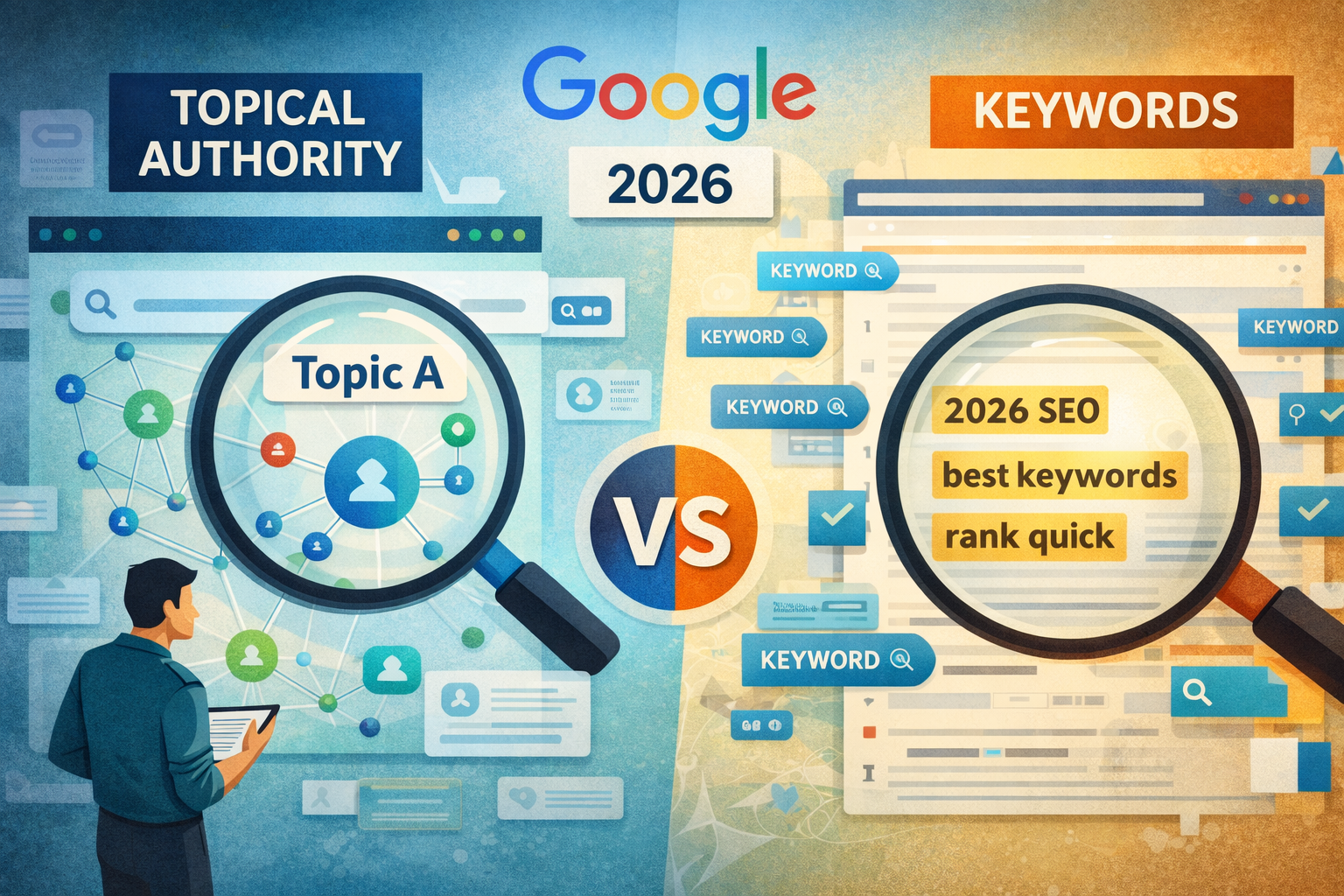
The SEO landscape has undergone a seismic shift, and the old playbook of keyword stuffing and exact-match optimization is not just outdated,it’s actively harmful to your rankings. As we navigate through 2026, Google’s algorithms have become increasingly sophisticated, prioritizing something far more nuanced than simple keyword matching: topical authority. Understanding this shift and adapting your content strategy accordingly isn’t optional anymore; it’s the difference between thriving in search results and becoming invisible.
For years, SEO practitioners obsessed over keywords. They meticulously researched search volumes, analyzed keyword difficulty scores, and strategically placed exact-match phrases throughout their content. While this approach had its time and place, Google’s evolution has rendered this narrow focus insufficient and, in many cases, counterproductive.
Understanding Topical Authority: The New SEO Foundation
Topical authority refers to Google’s perception of your website as a comprehensive, trustworthy resource on a particular subject or cluster of related subjects. It’s not about ranking for one keyword or even a handful of keywords, it’s about demonstrating deep, broad expertise across an entire topic area.
When your site has strong topical authority, Google understands that you’re not just creating scattered content to chase traffic. Instead, you’ve built a knowledge hub that thoroughly covers a subject from multiple angles, answers related questions comprehensively, and provides genuine value to users seeking information in that domain.
Think of it this way: if someone searches for information about sustainable gardening, Google doesn’t just want to show them a single article about “how to start a sustainable garden.” It wants to direct them to a website that covers sustainable gardening comprehensively, soil health, composting methods, water conservation, native plants, organic pest control, seasonal planning, and everything in between. That’s topical authority.
Why Google Made This Shift
Google’s ultimate goal has always been to provide the best possible answers to user queries. The company realized that websites focusing narrowly on individual keywords often created thin, fragmented content that didn’t truly serve users’ needs. Someone searching for information rarely has just one isolated question, they typically need comprehensive understanding.
Additionally, the rise of AI-generated content flooded the internet with keyword-optimized but shallow articles. Google needed more sophisticated ways to distinguish genuinely valuable resources from content farms gaming the system with keyword manipulation.
The integration of natural language processing, BERT, MUM, and other advanced AI technologies into Google’s algorithms enabled the search engine to understand context, relationships between concepts, and the depth of coverage a website provides. Google can now evaluate whether your site demonstrates true expertise or just surface-level keyword targeting.
The Limitations of Keyword-Only Strategies in 2026
Relying solely on keyword research and optimization in 2026 comes with significant drawbacks. Keyword-focused content tends to be narrow and transactional, missing the broader context users actually need. When you optimize a single page for a single keyword, you create isolated islands of content that don’t connect to form a cohesive knowledge base.
This approach also makes you vulnerable to algorithm updates. Google continuously refines how it evaluates content quality, and keyword-stuffed pages that lack depth are often the first casualties of these updates. You might rank well temporarily, but sustained success requires more substance.
Furthermore, keyword-only strategies often lead to keyword cannibalization, where multiple pages on your site compete for the same terms, confusing Google about which page should rank and ultimately weakening all of them. They also fail to capture the long-tail variations and semantic searches that increasingly dominate how people actually use search engines.
Perhaps most importantly, keyword-focused content rarely builds brand loyalty or establishes you as a trusted authority. Visitors who land on a thin, keyword-optimized page get their answer and leave, never returning. They don’t remember your brand or trust you for future information needs.
How to Build Topical Authority: A Comprehensive Approach
Building topical authority requires strategic planning and consistent execution. Start by choosing your topic pillars carefully, select two to five broad subject areas where you can genuinely demonstrate expertise and that align with your business goals. Trying to be an authority on too many unrelated topics dilutes your efforts and confuses both Google and your audience.
Once you’ve identified your pillars, create a content hub architecture. For each pillar topic, develop a comprehensive pillar page that provides a thorough overview of the entire subject. This should be substantial, typically three thousand to five thousand words or more, covering all major subtopics and serving as the authoritative guide.
From this pillar page, create cluster content, detailed articles that dive deep into specific subtopics. Each cluster article should thoroughly explore one aspect of the broader pillar topic and link back to the pillar page. The pillar page should also link out to all relevant cluster content, creating a tightly interconnected web of related information.
Cover your chosen topics exhaustively. Don’t just write about the popular, high-volume keywords. Address the questions beginners ask, the advanced concepts experts want to explore, the common problems people face, the tools and resources they need, and the emerging trends in your field. This comprehensive coverage signals to Google that you’re a genuine authority.
Maintain content quality consistently across all your topical content. Every piece should demonstrate expertise, incorporate original insights or research, provide practical value users can act on, and be well-written and properly structured. Consistency in quality reinforces your authority far more effectively than occasional exceptional pieces surrounded by mediocre content.
The Role of Keywords Within Topical Authority
This doesn’t mean keywords are irrelevant, far from it. Keywords remain important, but their role has evolved. Instead of being the foundation of your strategy, they’re now tools for understanding user intent and ensuring your comprehensive topical content addresses the specific ways people search for information.
Use keyword research to identify the questions and subtopics you should cover within your pillar content. Look for semantic variations and related terms that indicate what aspects of your topic matter most to users. Incorporate keywords naturally within your comprehensive content rather than forcing them artificially.
The key difference is that you’re no longer creating individual pages to target individual keywords. Instead, you’re building comprehensive resources that naturally rank for hundreds of related keywords because they thoroughly cover the topic.
Measuring Topical Authority Success
Traditional keyword ranking tracking still has value, but it’s no longer the primary success metric. Instead, monitor your overall visibility for topic-related searches across many keywords, not just a few targets. Track whether you’re ranking for informational queries, comparison searches, and various long-tail variations related to your pillar topics.
Observe your internal linking structure and how well your content clusters connect. Strong topical authority creates a web where users and search engines can easily navigate between related pieces of content. Watch for increasing traffic to multiple pages within a topic cluster rather than just one or two top-performing pages.
Pay attention to user engagement metrics, time on site, pages per session, and return visitor rates. When you’ve built true topical authority, users recognize your site as valuable and return for additional information, exploring multiple articles during their visits.
The Future-Proof Strategy
As we progress through 2026 and beyond, the trend toward topical authority will only intensify. Google’s algorithms continue evolving toward understanding content at a conceptual level rather than just matching keywords. Websites that establish themselves as comprehensive, authoritative resources in specific domains will increasingly dominate search results.
The transition from keyword-focused SEO to authority-based SEO requires more initial effort and strategic thinking, but it creates sustainable, long-term results that aren’t vulnerable to every algorithm tweak. Build your expertise, cover your topics thoroughly, and let keywords guide rather than dictate your content strategy. That’s what Google prefers in 2026, and that’s what will drive your success.