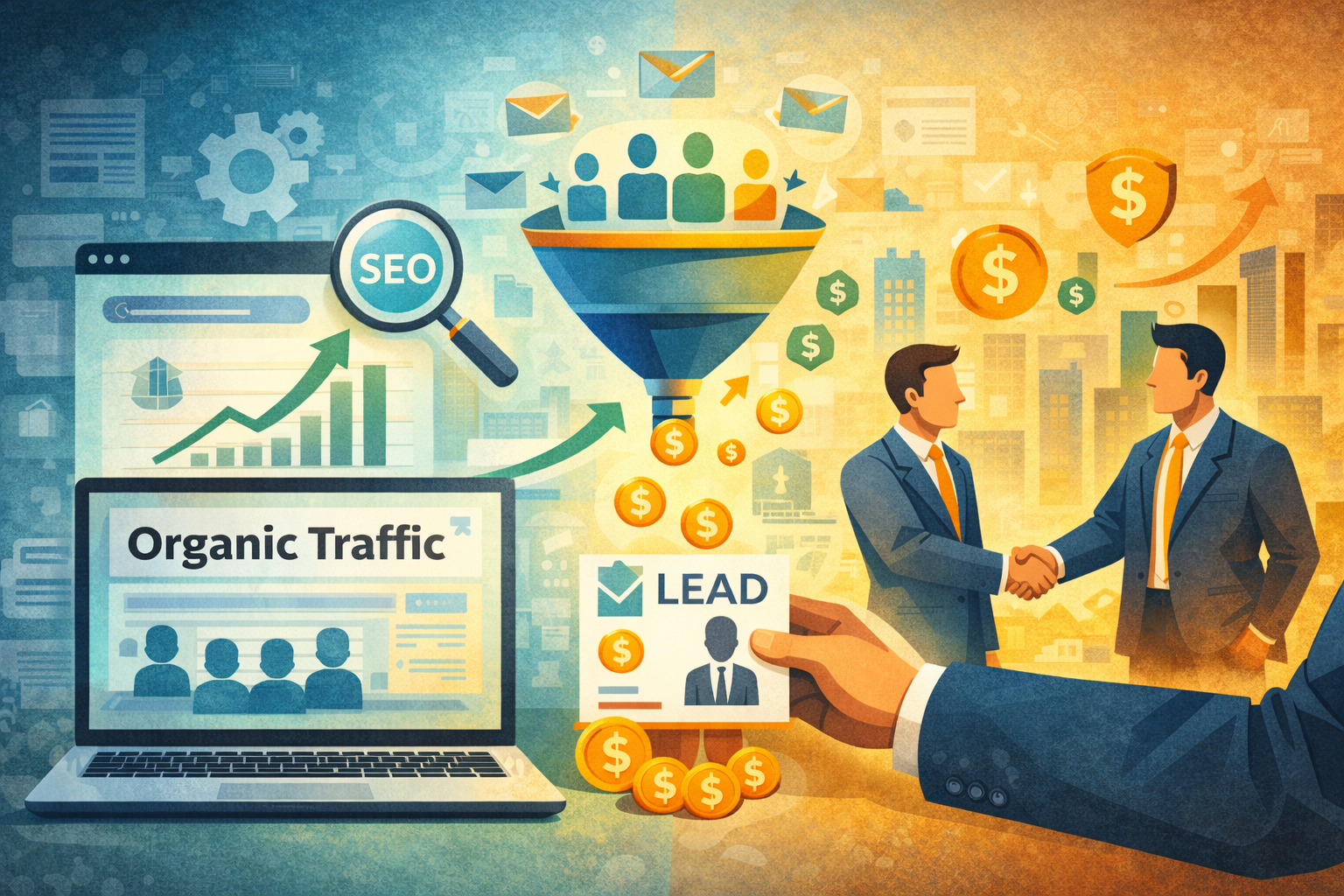
Congratulations, your SEO efforts are paying off, and organic traffic is flowing to your website. You’re watching those visitor numbers climb, and it feels like progress. But here’s the uncomfortable truth that many marketers eventually face: traffic without conversions is just a vanity metric. Unless those visitors are transforming into sales-ready leads that your team can actually close, all that traffic represents wasted potential and missed revenue.
The gap between attracting visitors and generating qualified leads is where most businesses struggle. People land on your site, consume some content, and disappear, never to be heard from since. They don’t fill out forms, don’t request demos, don’t engage with your sales team, and don’t become customers. They’re just ghosts passing through your analytics dashboard.
Turning organic traffic into sales-ready leads isn’t about luck or hoping the right people stumble upon your contact form. It requires strategic planning, psychological understanding of buyer behavior, and systematic optimization of every touchpoint in the visitor journey. Let’s explore exactly how to bridge this critical gap and transform your organic traffic into a predictable pipeline of qualified opportunities.
Understanding What Makes a Lead “Sales-Ready”
Before diving into conversion tactics, you need clarity on what constitutes a sales-ready lead for your business. Not all leads are created equal, and passing poorly qualified contacts to your sales team wastes everyone’s time and erodes trust between marketing and sales departments.
Sales-ready leads typically meet specific criteria that indicate genuine purchase potential. They have a clearly defined problem or need that your solution addresses, possess budget authority or access to decision-makers who control budgets, operate within your ideal customer profile regarding company size, industry, or other qualifying factors, demonstrate timeline urgency indicating they’re actively seeking solutions rather than casually browsing, and show engagement signals suggesting serious interest rather than passive information gathering.
Defining these criteria explicitly, ideally in collaboration with your sales team, creates alignment on what marketing should actually be delivering. This shared understanding prevents the common scenario where marketing celebrates lead volume while sales complains about lead quality.
Segmenting Traffic by Intent and Qualification Potential
Not every visitor arriving via organic search has equal potential to become a sales-ready lead. Someone searching “what is content marketing” is in a very different place than someone searching “enterprise content marketing platform pricing comparison.” Your conversion strategy must account for these intent differences.
Implement traffic segmentation based on the search queries and pages driving visits. Create distinct conversion paths for top-of-funnel educational content where visitors are just beginning to understand their problems, middle-of-funnel consideration content where prospects are evaluating different solution approaches, and bottom-of-funnel decision content where they’re comparing specific vendors and ready to engage.
Use behavior-based segmentation to identify high-intent visitors. Someone who visits your pricing page, reads three case studies, and downloads a product comparison guide is demonstrating significantly higher purchase intent than someone who reads one blog post and leaves. Your conversion mechanisms should reflect these behavioral signals, presenting more aggressive calls-to-action to high-intent visitors while nurturing early-stage visitors with less demanding asks.
Creating Conversion-Optimized Content Experiences
The content that ranks well in search engines must do double duty, satisfying both search algorithms and visitor conversion goals. Too many companies treat these as separate objectives, creating SEO content that ranks but doesn’t convert, or sales-focused landing pages that never attract organic traffic. Excellence requires integrating both purposes seamlessly.
Structure your content to guide visitors toward conversion naturally. Start with valuable information that fulfills their search intent, building trust and demonstrating expertise. Then transition smoothly into how your solution addresses the problems you’ve discussed, making the connection between their needs and your offering feel like a natural progression rather than an abrupt sales pitch.
Embed strategic conversion opportunities throughout your content rather than relegating them to a single form at the bottom. Include relevant calls-to-action in contextually appropriate places, a comparison guide mentioned within an article about evaluation criteria, a calculator tool referenced when discussing ROI considerations, or a case study showcased when addressing implementation concerns. These contextual offers convert better because they feel helpful rather than interruptive.
Design content upgrades specifically aligned with each piece of content. Someone reading “The Complete Guide to Email Deliverability” might readily exchange their email address for a downloadable checklist, template, or advanced resource on the same topic. This content-specific approach converts far more effectively than generic newsletter signup requests.
Implementing Progressive Profiling and Lead Nurturing
The biggest conversion killer is asking for too much information too soon. Lengthy forms demanding job titles, company size, budget ranges, and detailed requirements before providing any value create massive friction. Most visitors simply abandon rather than complete these interrogations.
Instead, implement progressive profiling that gathers information gradually over multiple interactions. The first conversion might request only an email address in exchange for valuable content. Subsequent interactions can request additional details as the relationship and trust deepen. This approach maximizes initial conversion rates while still ultimately collecting the qualification information your sales team needs.
Develop automated nurturing sequences that continue educating and qualifying leads after initial conversion. Someone who downloads an introductory guide receives follow-up emails with progressively more advanced content, case studies demonstrating results, and eventually direct offers for consultations or demos. This nurturing accomplishes two goals, it keeps your brand top-of-mind as prospects move through their buying journey, and it allows behavioral tracking that identifies when leads become sales-ready based on their engagement patterns.
Score leads based on both demographic information and behavioral signals. Assign points for company characteristics that match your ideal customer profile, and add points for high-intent behaviors like visiting pricing pages, watching product videos, downloading comparison guides, or repeatedly returning to your site. When lead scores reach defined thresholds, they trigger handoff to sales as qualified opportunities.
Optimizing Conversion Points for Maximum Impact
Every conversion element on your site deserves testing and optimization. Small improvements in conversion rates compound dramatically across thousands of monthly visitors. A landing page converting at two percent versus three percent means fifty percent more leads from the same traffic, that’s substantial business impact from seemingly modest optimization.
Test your calls-to-action systematically. Experiment with different button copy, “Get Started” versus “Request Demo” versus “See Pricing” can produce surprisingly different results. Try various button colors, sizes, and placements. Test whether multiple CTAs throughout a page outperform a single prominent one.
Optimize your forms ruthlessly. Every additional form field decreases completion rates. Question whether you truly need each piece of information at the initial conversion point, or whether you could gather it later. Test multi-step forms against single-page forms, sometimes breaking a long form into multiple short steps actually increases completion by reducing perceived effort.
Reduce anxiety and build trust at conversion points. Include trust signals like customer logos, testimonials, security badges, and privacy assurances near your forms. Make it explicitly clear what happens after form submission, will they receive an immediate download, schedule a call, or get an email? Uncertainty breeds hesitation.
Ensure your conversion mechanisms work flawlessly across all devices. Mobile traffic often represents half or more of organic visitors, yet many conversion forms remain mobile-hostile. Test your entire conversion process on smartphones and tablets, identifying and eliminating any friction points.
Leveraging Retargeting and Multi-Touch Engagement
Most visitors won’t convert on their first visit, but that doesn’t mean they’re lost opportunities. Implement strategic retargeting to re-engage visitors who showed interest but didn’t convert initially.
Build retargeting audiences based on specific behaviors and pages visited. Someone who viewed your pricing page deserves different messaging than someone who only read a blog post. Create segmented campaigns that speak to where visitors are in their journey and what they’ve already learned about your solution.
Use email retargeting when you’ve captured addresses through early-stage content offers. If someone downloaded a guide but hasn’t taken further action, automated sequences can provide additional value while gradually introducing more conversion-focused offers. The key is providing genuine value in each touch rather than just repeatedly asking for the sale.
Implement exit-intent technology that detects when visitors are about to leave and presents targeted offers at that moment. This might be a content upgrade, a limited-time consultation offer, or a simple email subscription invitation. While exit-intent can feel aggressive if overused, strategic deployment captures conversions that would otherwise be completely lost.
Creating Friction-Free Paths to Sales Conversations
For high-value B2B products or complex services, the ultimate conversion goal is often getting prospects into direct sales conversations. Make this path as friction-free as possible for visitors demonstrating high intent.
Implement conversational tools like live chat or chatbots that engage visitors in real-time. Someone spending ten minutes on your pricing page is probably interested, proactive chat invitations at opportune moments can convert fence-sitters into conversations. Ensure these tools qualify visitors appropriately rather than just collecting contact information for follow-up that may never happen.
Offer flexible engagement options that respect different communication preferences. Some prospects prefer scheduling formal demos, others want quick phone conversations, and many appreciate the ability to start with asynchronous communication like email or recorded video presentations. Providing options increases conversion by accommodating individual preferences.
Reduce scheduling friction by using calendar tools that let prospects book time directly rather than enduring back-and-forth email exchanges finding mutual availability. Every additional interaction required to complete a conversion creates opportunity for prospects to disengage or deprioritize.
Measuring and Optimizing the Complete Funnel
Turning organic traffic into sales-ready leads requires measuring and optimizing the complete conversion funnel, not just individual metrics in isolation. Track visitor-to-lead conversion rates overall and by traffic source, page, and visitor segment. Monitor lead-to-opportunity conversion rates to understand what percentage of marketing leads actually qualify for sales engagement. Measure opportunity-to-customer conversion to determine which lead sources ultimately produce revenue.
Identify drop-off points in your funnel. Are visitors bouncing from landing pages without scrolling? Are they abandoning forms halfway through? Are qualified leads failing to respond to sales outreach? Each drop-off point represents optimization opportunity.
Calculate the revenue value of conversion rate improvements. Understanding that increasing your landing page conversion rate from two to three percent would generate X additional qualified leads worth Y potential revenue helps prioritize optimization efforts and justify investment in conversion rate optimization resources.
Building a Conversion-Focused Culture
Ultimately, turning organic traffic into sales-ready leads isn’t about implementing a few tactical tricks, it’s about building an organizational culture that obsesses over conversion at every step. This means continuously testing and improving conversion elements, aligning marketing and sales around lead qualification criteria, creating feedback loops where sales insights inform marketing optimization, investing in the tools and technologies that enable sophisticated conversion tracking and automation, and maintaining patience through the iterative process of funnel optimization.
Your organic traffic represents enormous potential, visitors who found you because they were actively searching for solutions to problems you can solve. Converting that potential into revenue-generating leads isn’t magic; it’s methodical optimization of every touchpoint in the journey from stranger to sales-ready prospect. Start measuring your current conversion performance, identify the biggest gaps, and systematically work to bridge them. The leads, and revenue, will follow.